Protected Objects Snapshot Report
The Protected Objects Snapshot report lists the status of protected and unprotected Outlook, OneDrive, SharePoint and Teams objects at a given point in time. This report is available only for the Microsoft 365 workload.
Generating Protected Objects Snapshot Report
To generate the Protected Objects Snapshot report, do the following:
-
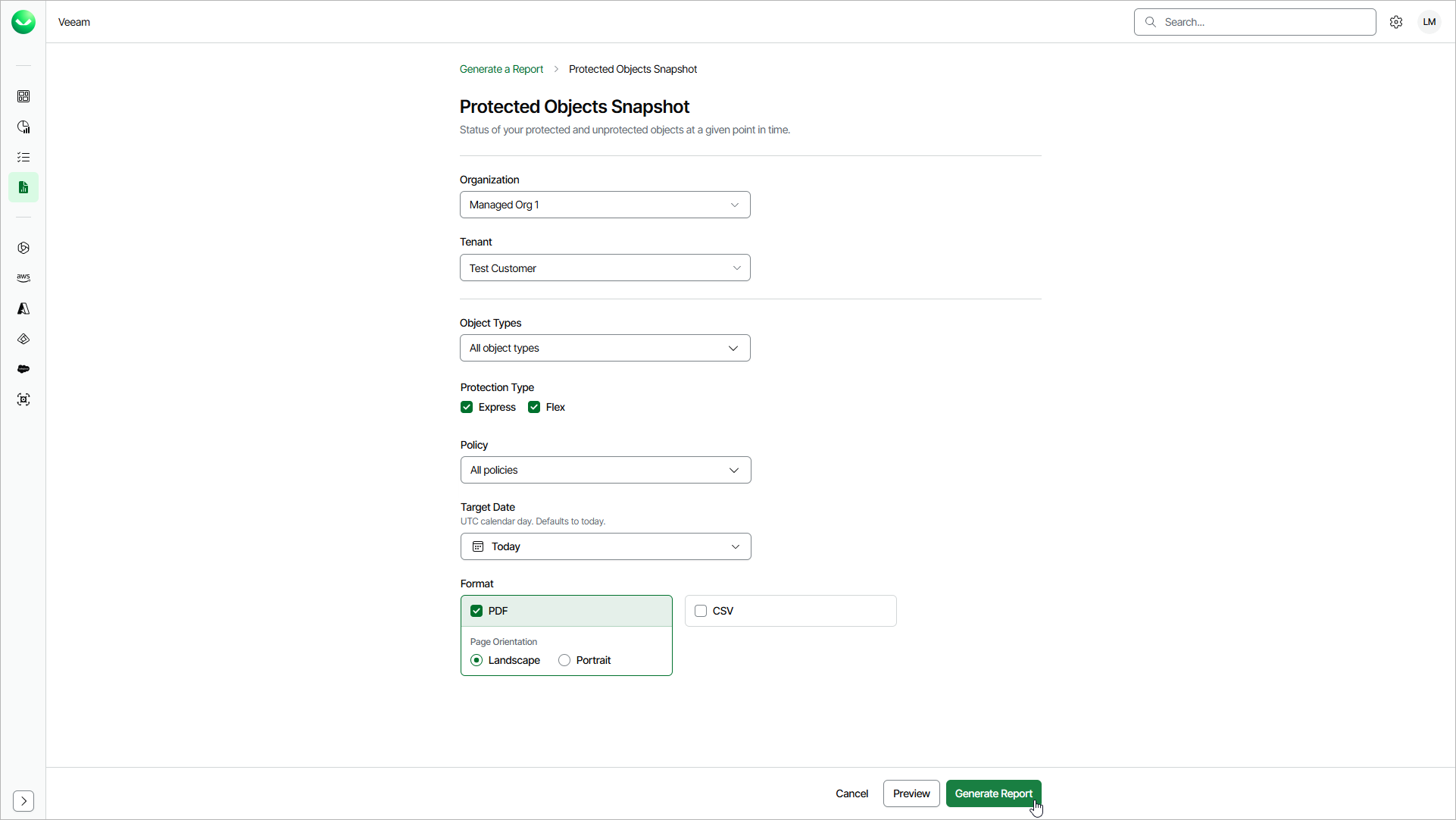
Click the reports icon on the left and click Generate Now.
- On the Generate a Report page, click Protected Objects Snapshot.
- From the Organization drop-down list, select the organization to which the tenant belongs. By default, All Organizations is selected.
- If the organization has more than one tenant, from Tenant drop-down list, select the tenant for which you want to generate the report.
- From the Object Types drop-down list, select one or more types of objects that you want to include in the report. The available object types are the following: Outlook, OneDrive, SharePoint and Teams. By default, the report includes all object types.
- If the tenant has an express backup policy, in the Protection Type section, select the Express check box, the Flex check box or both. The report will include objects protected by backup policies of the selected types.
- From the Policy drop-down list, select one or more backup policies whose objects you want to include in the report. By default, the report includes objects of all backup policies.
- In the Target Date field, select the day for which you want to generate the report. The day is counted in UTC. By default, Today is selected.
- In the Format section, select the PDF check box, the CSV check box or both. For PDF, select the page orientation: Landscape or Portrait.
- [Optional] To view an interactive preview of the report, click Preview. For details, see Previewing Protected Objects Snapshot Report.
- Click Generate Report. Veeam Data Cloud for Microsoft 365 will generate the report in the selected formats.
Downloading Protected Objects Snapshot Report
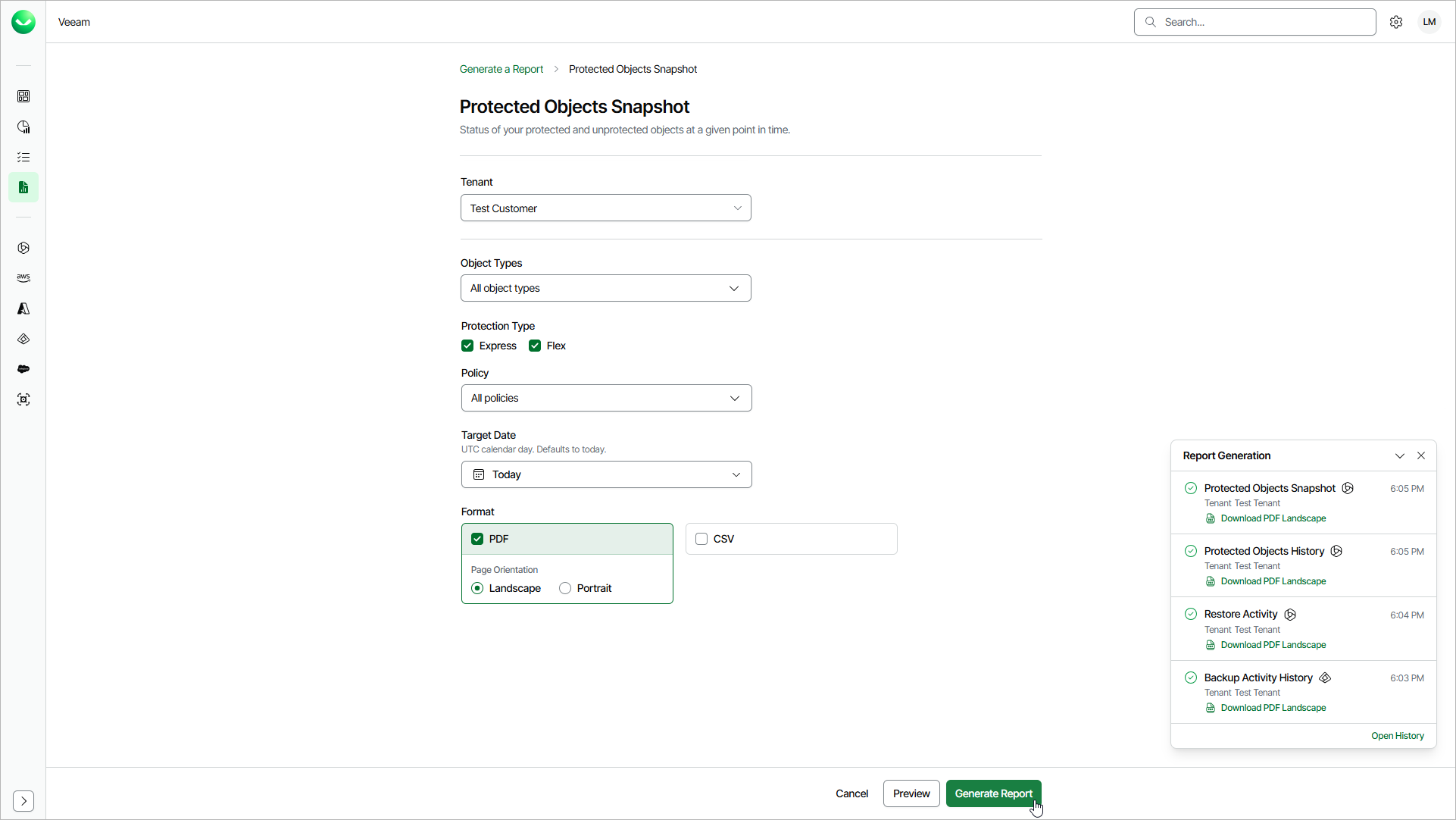
After you click Generate Report, Veeam Data Cloud opens the Report Generation panel in the lower-right corner of the page. The panel displays the status of the report: Queued, Generating or Ready.
To download the report, do the following:
- Wait until the status of the report in the Report Generation panel changes to Ready.
- Click Download PDF or Download CSV. The report is saved to your browser download location.
The Report Generation panel displays the five latest reports generated during the last day. To download an earlier report, use the History page. For details, see Viewing Report History.
Previewing Protected Objects Snapshot Report
To preview the Protected Objects Snapshot report, specify the report settings and click Preview.
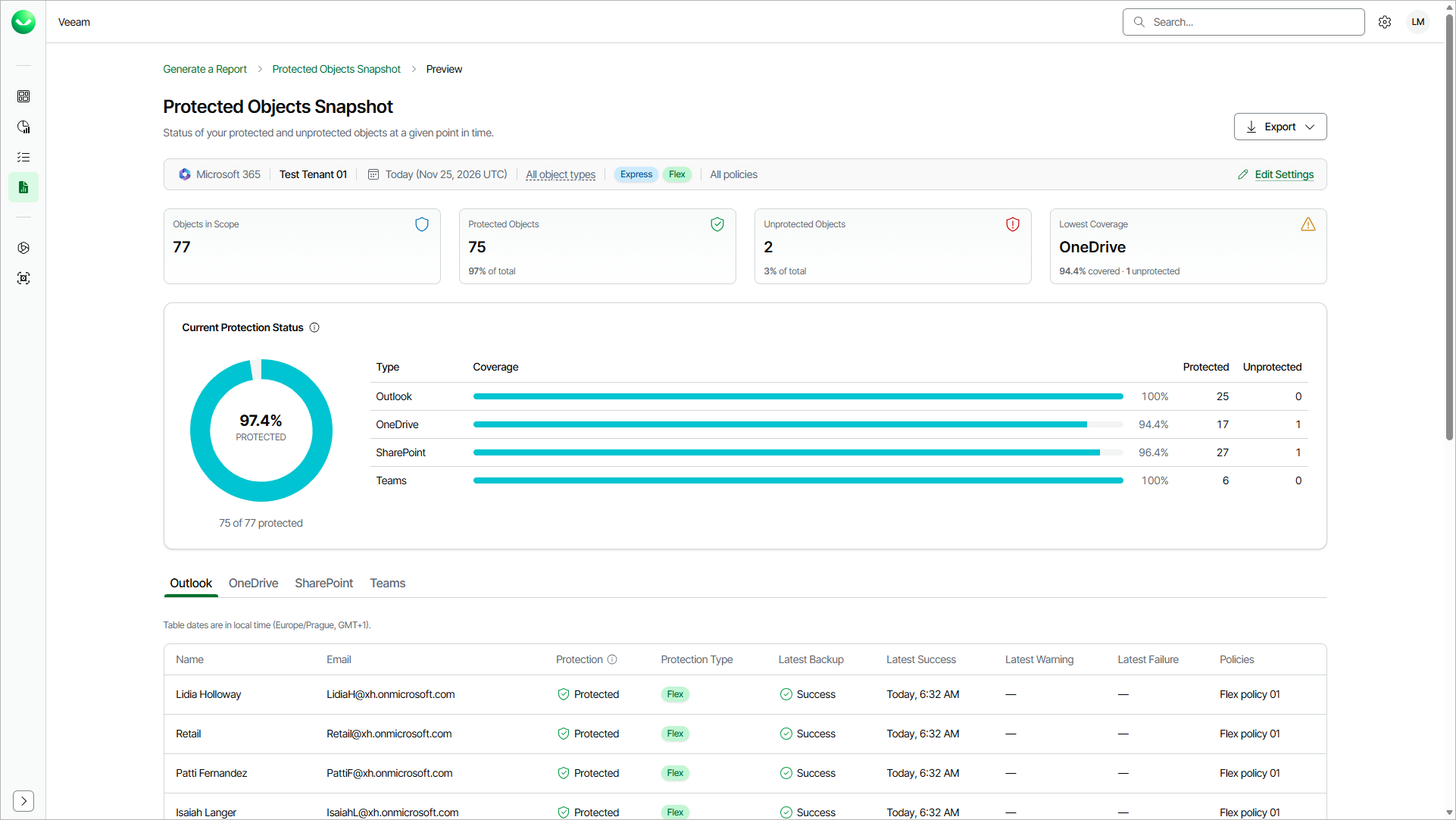
At the top of the preview page, Veeam Data Cloud displays a summary of the report settings: the workload, tenant, target date, object types, protection types and policies. To change the report settings, click Edit Settings.
In the summary section, Veeam Data Cloud displays the following information.
|
Property |
Description |
|---|---|
|
Objects in Scope |
Total number of objects included in the report |
|
Protected Objects |
Number and percentage of protected objects |
|
Unprotected Objects |
Number and percentage of unprotected objects |
|
Lowest Coverage |
Object type with the lowest protection coverage, the percentage of protected objects and the number of unprotected objects of this type |
In the Current Protection Status section, Veeam Data Cloud displays the percentage of protected objects among all objects included in the report and the following information for each object type.
|
Property |
Description |
|---|---|
|
Type |
Object type: Outlook, OneDrive, SharePoint or Teams |
|
Coverage |
Percentage of protected objects |
|
Protected |
Number of protected objects |
|
Unprotected |
Number of unprotected objects |
In the Outlook, OneDrive, SharePoint and Teams tabs, Veeam Data Cloud displays details on objects of the corresponding type. Dates in the table are displayed in your local time. The table contains the following columns.
|
Property |
Description |
|---|---|
|
Name |
Name of the user, SharePoint site or team |
|
|
[For Outlook and OneDrive] Email address of the user |
|
URL |
[For OneDrive and SharePoint] URL of the OneDrive or SharePoint site |
|
Protection |
Protection status of the object: Protected or Unprotected |
|
Protection Type |
Type of the backup policy that protects the object: Flex or Express |
|
Latest Backup |
Status of the latest backup policy session: Success, Warning, Error or No status |
|
Latest Success |
Date and time of the latest successful backup policy session |
|
Latest Warning |
Date and time of the latest backup policy session with the Warning status |
|
Latest Failure |
Date and time of the latest failed backup policy session |
|
Policies |
Names of the backup policies that include the object |
|
Note |
|
An object is Protected when it has at least one successful backup (or backup with warnings) within its RPO at the report date. Objects with neither a successful backup nor a backup with warnings in that window, objects whose policy has not run yet and objects not covered by any backup policy are Unprotected. |
Protected Objects Snapshot Report CSV Fields
If you generate the Protected Objects Snapshot report in the CSV format, the .CSV file contains the following fields.
|
Property |
Description |
|---|---|
|
Object Type |
Type of the object: Mailbox, OneDrive, SharePoint or Teams |
|
Name |
Name of the user, SharePoint site or team |
|
|
Email address of the user |
|
URL |
URL of the OneDrive or SharePoint site |
|
Tenant |
Name of the tenant |
|
Protection Status |
Protection status of the object: Protected or Unprotected |
|
Protection Type |
Type of the backup policy that protects the object: Flex or Express |
|
Latest Backup Status |
Status of the latest backup policy session: Success, Warning, Error or No status |
|
Last Successful Backup |
Date and time of the latest successful backup policy session |
|
Last Warning Backup |
Date and time of the latest backup policy session with the Warning status |
|
Last Error Backup |
Date and time of the latest backup policy session with the Error status |
|
Backup Policies |
Names of the backup policies that include the object |
|
Total |
Total number of objects, protected objects and unprotected objects |
For example:
|
Object Type,Name,Email,URL,Tenant,Protection Status,Protection Type,Latest Backup Status,Last Successful Backup,Last Warning Backup,Last Error Backup,Backup Policies,TOTAL |