MySQL Database Processing Settings
Before You Begin
Veeam Agent locks all MySQL tables that use storage engines other than InnoDB, for example MyISAM, MEMORY, ARCHIVE or CSV, while it creates the system snapshot. InnoDB tables are transactional and are captured consistently by the snapshot. Veeam Agent does not lock InnoDB tables by default.
To detect and lock non-InnoDB tables, the MySQL account used by Veeam Agent must have the following privileges:
SELECT— Required to read table metadata and detect non-InnoDB tables. Grant this privilege on every database that contains such tables. If the account lacksSELECTon a database, Veeam Agent cannot detect or lock its non-InnoDB tables. Processing completes successfully, but these tables may be captured in an inconsistent state.LOCK TABLES— Required to lock detected non-InnoDB tables. Grant this privilege on every database that contains such tables. If the account can detect a table but cannot lock it, MySQL database system processing fails. If successful application processing is not required, processing completes with a warning and the tables remain unlocked.FLUSH_TABLESorRELOAD— Required to run theFLUSH TABLES ... WITH READ LOCKstatement. This privilege must be granted instance-wide,ON *.*. If non-InnoDB tables are detected but the account has neither privilege, locking fails and MySQL database system processing fails. If successful application processing is not required, processing completes with a warning and the tables remain unlocked.FLUSH_TABLESis available in MySQL 8.0.23 and later. For earlier MySQL versions and MariaDB, useRELOAD.
To obtain information about the privileges that are assigned to an account, use MySQL functionality — for example, the SHOW GRANTS statement. To learn more, see MySQL documentation.
Specifying MySQL Processing Settings
To specify processing settings for the MySQL database system, do the following:
- In the Specify advanced job settings window, select the MySQL processing option with the [Tab] and [Down] keys and press [Enter].
- In the MySQL processing section, select one of the following options:
- Require successful processing. With this option selected, Veeam Agent will stop the backup process if an error occurs when processing the MySQL database system.
- Try application processing, ignore failures. With this option selected, Veeam Agent will continue the backup process even if errors occur when processing the MySQL database system.
- In the Authentication method section, specify how Veeam Agent will connect to the MySQL database:
- Select Password if you want Veeam Agent to connect with the MySQL account name and password. With this option selected, you must specify account name and password in the backup job settings.
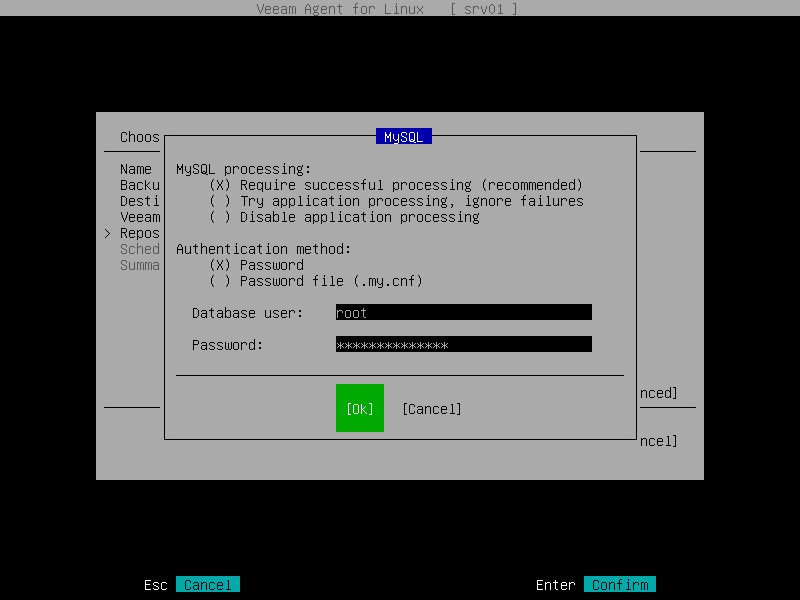
- Select Password file if you want Veeam Agent to connect with the MySQL account name and password that are stored in the
.my.cnfpassword file. With this option selected, you must specify a path to the password file, but do not need to specify account credentials in the backup job settings. To learn more about password file configuration, see Preparing Password File for MySQL Processing.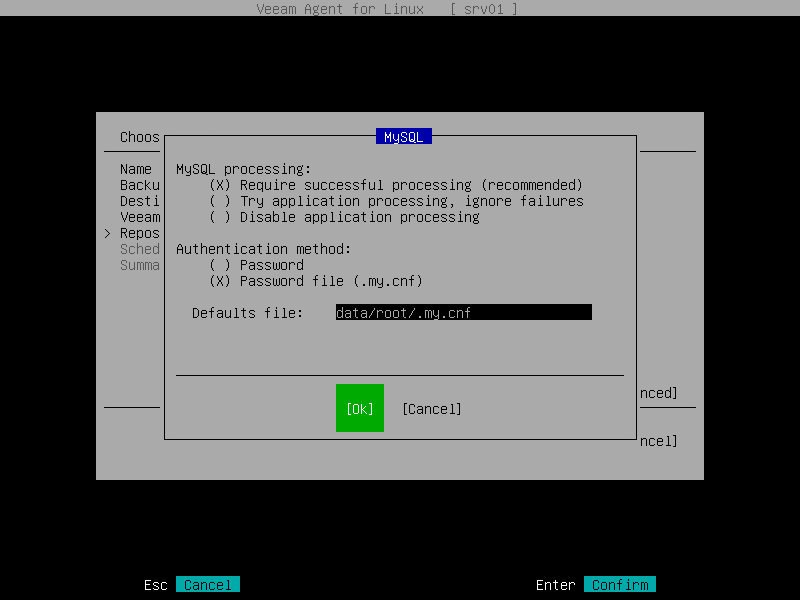
- Select Password if you want Veeam Agent to connect with the MySQL account name and password. With this option selected, you must specify account name and password in the backup job settings.