Entra ID Backup Activity History Report
The Backup Activity History report shows Entra ID backup runs over a time period, including the run results and the number of processed objects. You can use this report to check whether backups of the tenant run as expected and to find failed backup runs.
Generating Backup Activity History Report
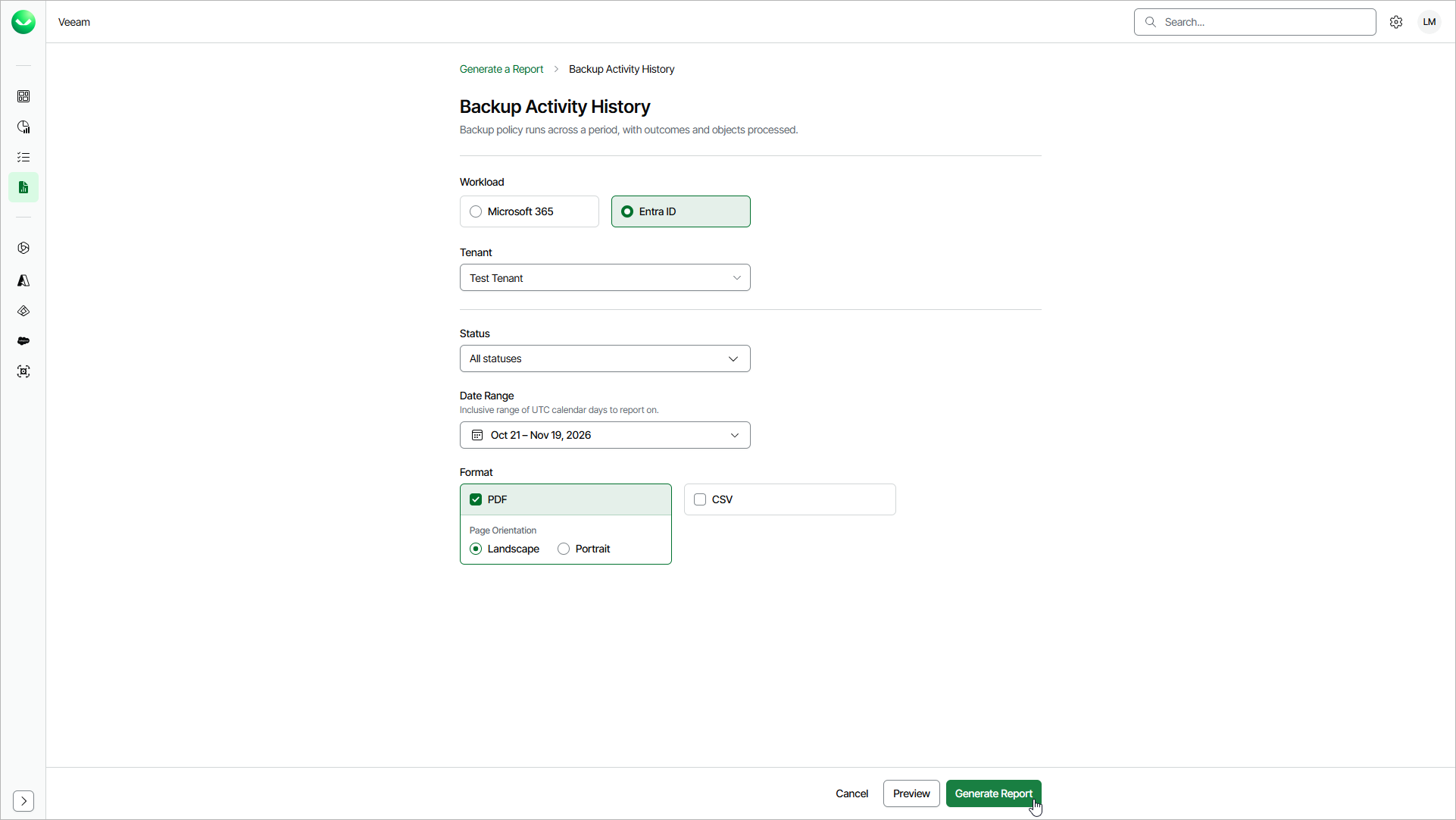
To generate the Backup Activity History report, do the following:
- Click the reports icon on the left and click Generate Now.
- On the Generate a Report page, click Backup Activity History.
- If the Workload section is displayed, select Entra ID.
- If the organization has more than one tenant, from Tenant drop-down list, select the tenant for which you want to generate the report.
- From the Status drop-down list, select one or more statuses of backup runs that you want to include in the report: Success, Warning, Failed or Aborted. By default, the report includes runs with all statuses.
- In the Date Range field, select the period for which you want to generate the report. The date range includes the first and the last day of the period. Days are counted in UTC.
- In the Format section, select the PDF check box, the CSV check box or both. For PDF, select the page orientation: Landscape or Portrait.
- [Optional] To view an interactive preview of the report, click Preview. For details, see Previewing Backup Activity History Report.
- Click Generate Report. Veeam Data Cloud will generate the report in the selected formats.
Downloading Backup Activity History Report
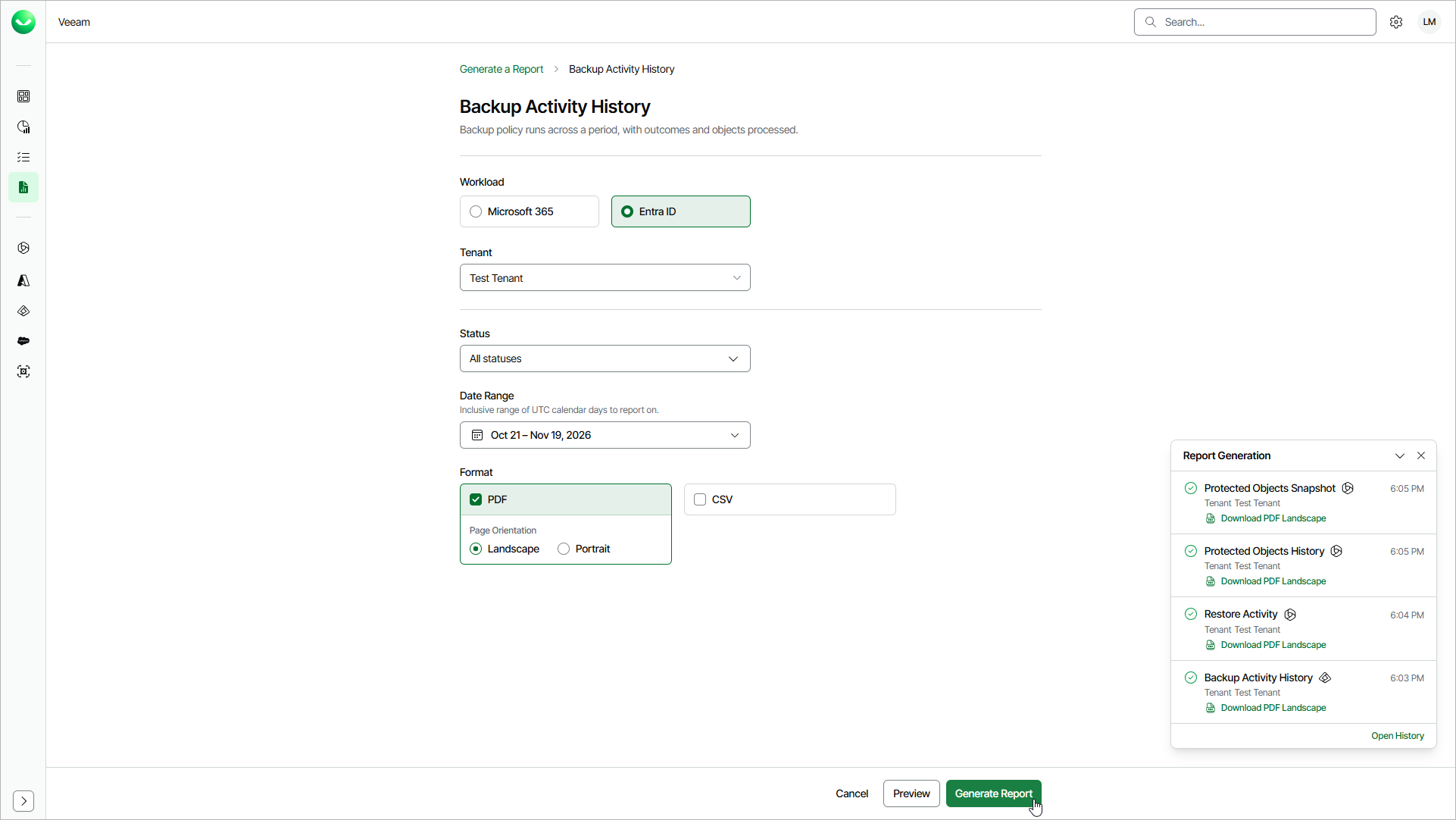
After you click Generate Report, Veeam Data Cloud opens the Report Generation panel in the lower-right corner of the page. The panel displays the status of the report: Queued, Generating or Ready.
To download the report, do the following:
- Wait until the status of the report in the Report Generation panel changes to Ready.
- Click Download PDF or Download CSV. The report is saved to your browser download location.
The Report Generation panel displays the five latest reports generated during the last day. To download an earlier report, use the History page. For details, see Viewing Report History.
Previewing Backup Activity History Report
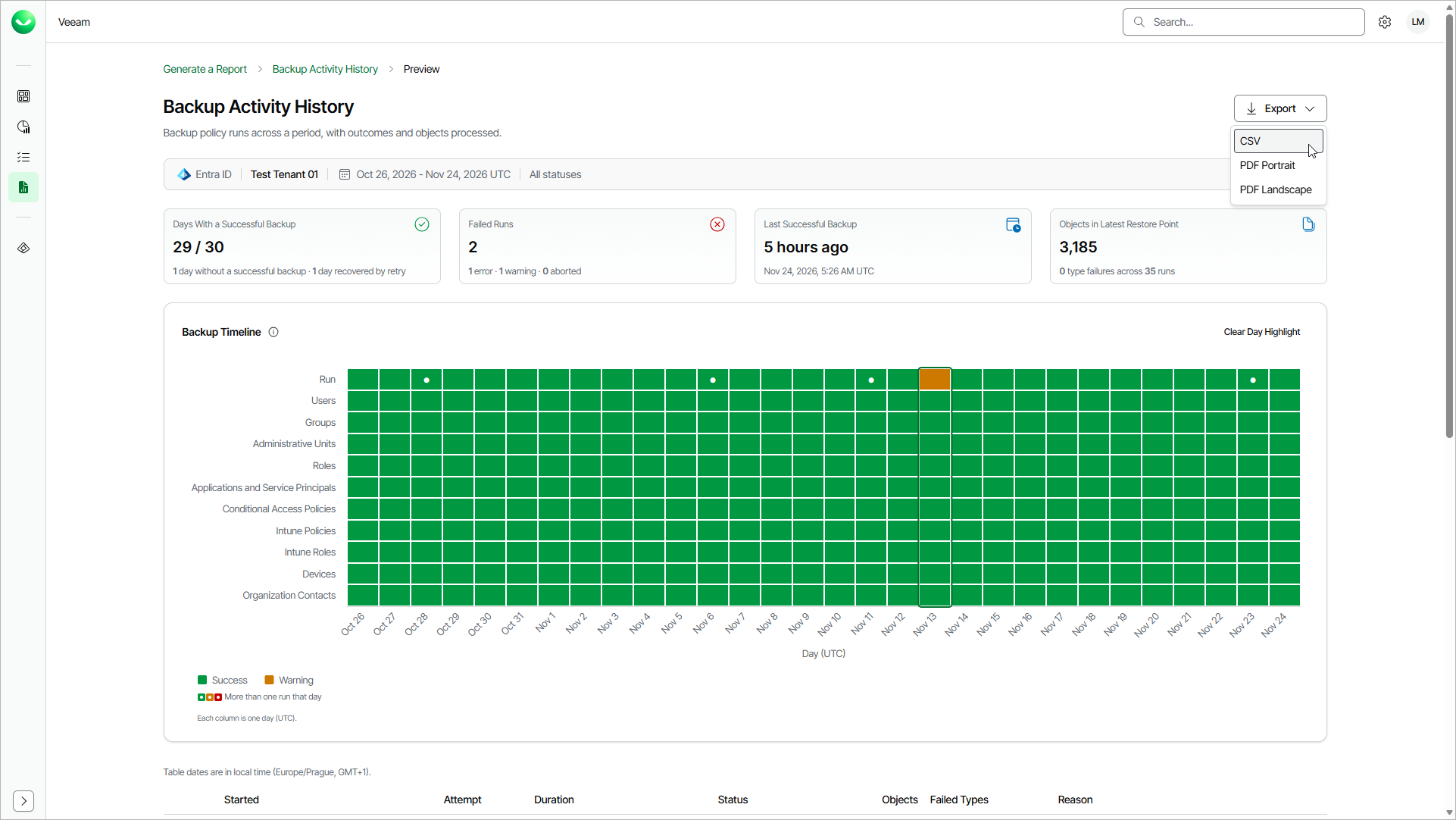
To preview the Backup Activity History report, specify the report settings and click Preview.
At the top of the preview page, Veeam Data Cloud displays a summary of the report settings: the workload, tenant, date range and statuses. To change the report settings, click Edit Settings.
In the summary section, Veeam Data Cloud displays the following information.
|
Property |
Description |
|---|---|
|
Days With a Successful Backup |
Number of days in the date range with a successful backup |
|
Failed Runs |
Number of failed backup runs |
|
Last Successful Backup |
Date and time of the latest successful backup run |
|
Objects in Latest Restore Point |
Number of objects in the latest restore point |
In the Backup Timeline section, Veeam Data Cloud displays the results of backup runs for each day of the date range. To highlight the backup runs of a specific day in the table, click this day. To remove the highlight, click Clear Day Highlight.
In the table, Veeam Data Cloud displays details on each backup run. Dates in the table are displayed in your local time. The table contains the following columns.
|
Property |
Description |
|---|---|
|
Started |
Date and time when the backup run started |
|
Attempt |
Number of the backup attempt, for example, 1 of 2. If a backup run is retried, the table displays a separate row for each attempt. |
|
Duration |
Duration of the backup run |
|
Status |
Status of the backup run |
|
Objects |
Number of processed objects |
|
Failed Types |
Types of objects that were not backed up |
|
Reason |
Reason for the backup run status |
To export the report from the preview page, click Export and select CSV, PDF Portrait or PDF Landscape.
Backup Activity History Report CSV Fields
If you generate the Backup Activity History report in the CSV format, the CSV file contains the following fields.
|
Property |
Description |
|---|---|
|
Tenant |
Name of the tenant |
|
Start Time (UTC) |
Date and time (in UTC) when the backup run started |
|
End Time (UTC) |
Date and time (in UTC) when the backup run ended |
|
Duration |
Duration of the backup run |
|
Retry Of |
Backup run that this run retries. The field is filled in only for retry attempts. |
|
Status |
Status of the backup run: Success, Warning, Failed or Aborted |
|
Reason |
Reason for the backup run status |
|
Object Types |
Types of objects processed in the backup run |
|
Objects Processed |
Number of objects processed in the backup run |
|
Objects in Restore Point |
Number of objects in the restore point created by the backup run |
|
Objects Failed |
Number of objects that were not backed up |
|
Users, Groups, Administrative Units, Roles, Applications and Service Principals, Conditional Access Policies, Intune Policies, Intune Roles, Devices, Organization Contacts |
Number of processed objects of each type |
|
Execution ID |
ID of the backup run |
The last row of the file, TOTAL, contains the total number of backup runs and the number of runs with each status.
For example:
|
Tenant,Start Time (UTC),End Time (UTC),Duration,Retry Of,Status,Reason,Object Types,Objects Processed,Objects in Restore Point,Objects Failed,Users,Groups,Administrative Units,Roles,Applications and Service Principals,Conditional Access Policies,Intune Policies,Intune Roles,Devices,Organization Contacts,Execution ID |