Predefined Tests
Veeam Backup & Replication can verify machines with the following predefined tests:
- Heartbeat test. When the machine starts, Veeam Backup & Replication performs a heartbeat test. It waits for a heartbeat signal from VMware Tools installed inside the machine to determine that the machine guest OS is running. If the signal comes regularly at specific time intervals, the test is passed.
- Ping test. Veeam Backup & Replication sends ping requests to the machine from the backup server and checks if the machine can respond to them. If the machine responds to ping requests, the test is passed.
- Application test. Veeam Backup & Replication waits for applications inside the machine to start and runs a script against these applications. Veeam Backup & Replication uses two types of predefined scripts:
- For DNS servers, domain controllers, Global Catalog servers, mail servers and web servers, Veeam Backup & Replication uses a script that probes an application-specific port. For example, to verify a domain controller, Veeam Backup & Replication probes port 389 for a response. If the response is received, the test is passed.
- [For Veeam Backup & Replication on Windows] For Microsoft SQL Server, Veeam Backup & Replication uses a script that attempts to connect to instances and databases on the Microsoft SQL Server. For more information, see Microsoft SQL Server Checker Script.
|
Note |
|
To run the heartbeat and ping tests, you must have VMware Tools installed on the machine. If VMware Tools are not installed, these tests will be skipped. |
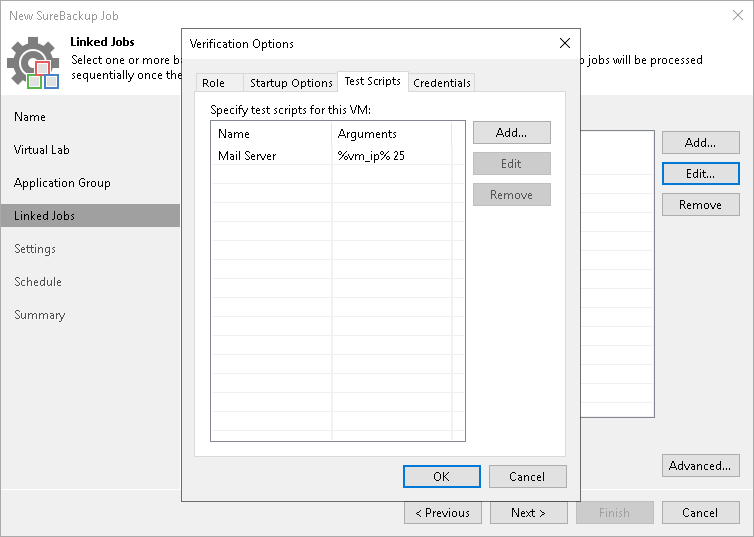
You can run verification tests for machines added to the application group or processed with a linked SureBackup job. You can specify and customize settings for verification tests in the application group or SureBackup job settings.
Microsoft SQL Server Checker Script
If you need to verify a virtualized Microsoft SQL Server, you can instruct Veeam Backup & Replication to run the Microsoft SQL Server Checker script against it during the SureBackup job. The script sequentially performs the following operations:
- Connects to Microsoft SQL Server instances.
- Enumerates databases on these instances.
- Employs the USE SQL statement to connect to databases and check their availability.
The script is located on the backup server in the Veeam Backup & Replication product folder. The path by default: C:\Program Files\Veeam\Backup and Replication\Backup\Veeam.Backup.SqlChecker.vbs.
|
Important |
|
Consider the following:
|
Credentials for Script Execution
To execute the script, Veeam Backup & Replication connects to Microsoft SQL Server. By default, Veeam Backup & Replication uses the account under which the Veeam Backup Service is running. If you need to run the script under another account, you can specify credentials for this account. The script supports the following authentication methods:
- Microsoft Windows authentication mode. To use it, you must specify credentials for the account on the Credentials tab in the application group or SureBackup job settings.
- SQL Server authentication mode. To use it, you must pass credentials of the account to the script. You can pass credentials the following ways:
- By running the Microsoft SQL Server Checker Script from the PowerShell. To do it, use the following command in the PowerShell console:
|
cscript C:\Program Files\Veeam\Backup and Replication\Backup\Veeam.Backup.SqlChecker.vbs <sql server[\instance]> <username> <password> |
You can find the results of a script execution in the log file by the following path: %programdata%\Veeam\Backup\<name of the job>\<VM name>_SQLChecker.log. If necessary, you can change the log file location. To do this, specify a new path in the PowerShell command:
|
cscript C:\Program Files\Veeam\Backup and Replication\Backup\Veeam.Backup.SqlChecker.vbs [C:\Logs] <sql server[\instance]> <username> <password> |
- By modifying credentials in the Veeam.Backup.SqlChecker.vbs file. The script is located on the backup server in the Veeam Backup & Replication product folder. The default path: C:\Program Files\Veeam\Backup and Replication\Backup\Veeam.Backup.SqlChecker.vbs.
Database Exclusion
By default, Veeam Backup & Replication verifies all databases on all instances of Microsoft SQL Server. However, you can exclude specific databases from verification. For example, vCenter Server database. To exclude an instance or a database, you must open the script in the text editor and edit the Settings section in the following way:
- To exclude a specific databases, uncomment the gDBsToExclude.Push "dbname" line in the script and specify the names of a database that you want to exclude. To exclude several databases, specify a separate line for each database.
|
gDBsToExclude.Push "dbname1" gDBsToExclude.Push "dbname2" |
- To exclude a specific instance, uncomment the gInstancesToExclude.Push "instancename" line in the script and specify the name of an instance that you want to exclude. To exclude several instances, specify a separate line for each instance.
|
gInstancesToExclude.Push "instancename1" gInstancesToExclude.Push "instancename2" |
- To exclude the default instance, uncomment the gInstancesToExclude.Push "MSSQLSERVER" line.
|
Important |
|
Instance and database names are case sensitive. |
Logging
To define whether the script has completed successfully or not, Veeam Backup & Replication publishes the following return codes in the SureBackup job session statistics:
- 0 — test is passed successfully.
- 1 — you use a wrong syntax for the script command.
- 2 — Veeam Backup & Replication is unable to connect to Microsoft SQL Server.
- 3 — all instances are excluded from the check.
- 4 — error occurred while Veeam Backup & Replication was getting the list of databases.
- 5 — unknown error.
- 6 — one or more databases are not accessible.
Results of script execution are written to the log file located by the following path: %programdata%\Veeam\Backup\<name of the job>\<VM name>_SQLChecker.log. If necessary, you can change the log file location. To do this, pass a new path to the log file in the %log_path% argument in the application group or SureBackup job settings.