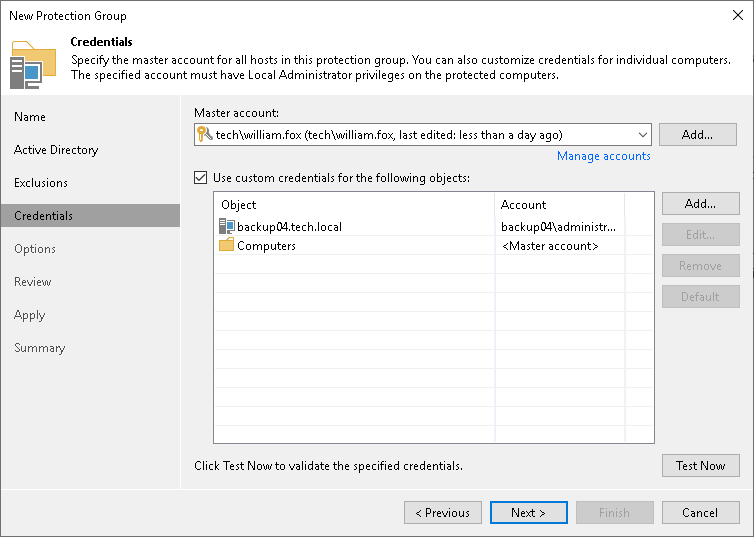
Step 5. Specify Credentials
At the Authentication Settings step of the wizard, specify the connection settings for computers included in the protection group. You can also customize authentication settings for individual objects.
Specifying Access
In the Access section, select a method to connect to computers included in the protection group:
- Use master account. From the Master account drop-down list, select a user account that has Local Administrator privileges on all computers that you have added to the protection group. Veeam Backup & Replication will use this account to connect to the protected computers and perform the necessary operations on them, such as uploading and installing Veeam Agent.
If you have not set up credentials beforehand, click the Manage accounts link or click Add on the right to add credentials.
The user name can be specified in the following formats:
- DNS.DOMAIN.NAME\USERNAME
- USERNAME@DNS.DOMAIN.NAME
- HOSTNAME\USERNAME — if you use Veeam Backup & Replication on Microsoft Windows
- DOMAIN\USERNAME — if you use Veeam Backup & Replication on Microsoft Windows
- Use certificate-based authentication. Select this option if you chose to pre-install Veeam Deployer Service on the computers that you want to add to the protection group. In this case, Veeam Backup & Replication will connect to the computers using a certificate. To learn more, see Deploying Veeam Agent Using Veeam Deployment Kit.
Customizing Authentication Settings per Object
By default, Veeam Backup & Replication uses the connection settings specified in the Access section for all computers in the protection group. If some computer or Active Directory object requires different authentication settings, do the following:
- Select the Use custom credentials for the following objects check box.
- Click Add next to the list of objects and select the necessary object in the Add Objects window.
Objects that you have added to the protection group at the Active Directory step of the wizard are already displayed in the Use custom credentials for the following objects list. In the Add Objects window, you can also select child objects for which you want to specify custom credentials. For example, you may want to specify separate credentials for different organization units, containers, groups or individual computers within the entire domain added to the protection group.
- In the Use custom credentials for the following objects list, select the necessary object, click Edit and select custom credentials or certificate-based authentication for the object. Credentials must be specified in the following format:
- For Active Directory accounts, if you use Veeam Backup & Replication on Linux — DNS.DOMAIN.NAME\USERNAME or USERNAME@DNS.DOMAIN.NAME.
- For Active Directory accounts, if you use Veeam Backup & Replication on Microsoft Windows — DOMAIN\USERNAME, DNS.DOMAIN.NAME\USERNAME or USERNAME@DNS.DOMAIN.NAME.
- For local accounts — USERNAME or HOSTNAME\USERNAME.
|
TIP |
|
To reset an object's authentication settings back to the master account, select the object in the list and click Default. To remove an object from the list, select it and click Remove. |
|
NOTE |
|
Consider the following:
|
To check if Veeam Backup & Replication can connect to computers added to the protection group, click Test Now. Veeam Backup & Replication will form a list of computers to connect and use the specified authentication settings to connect to computers in the list.