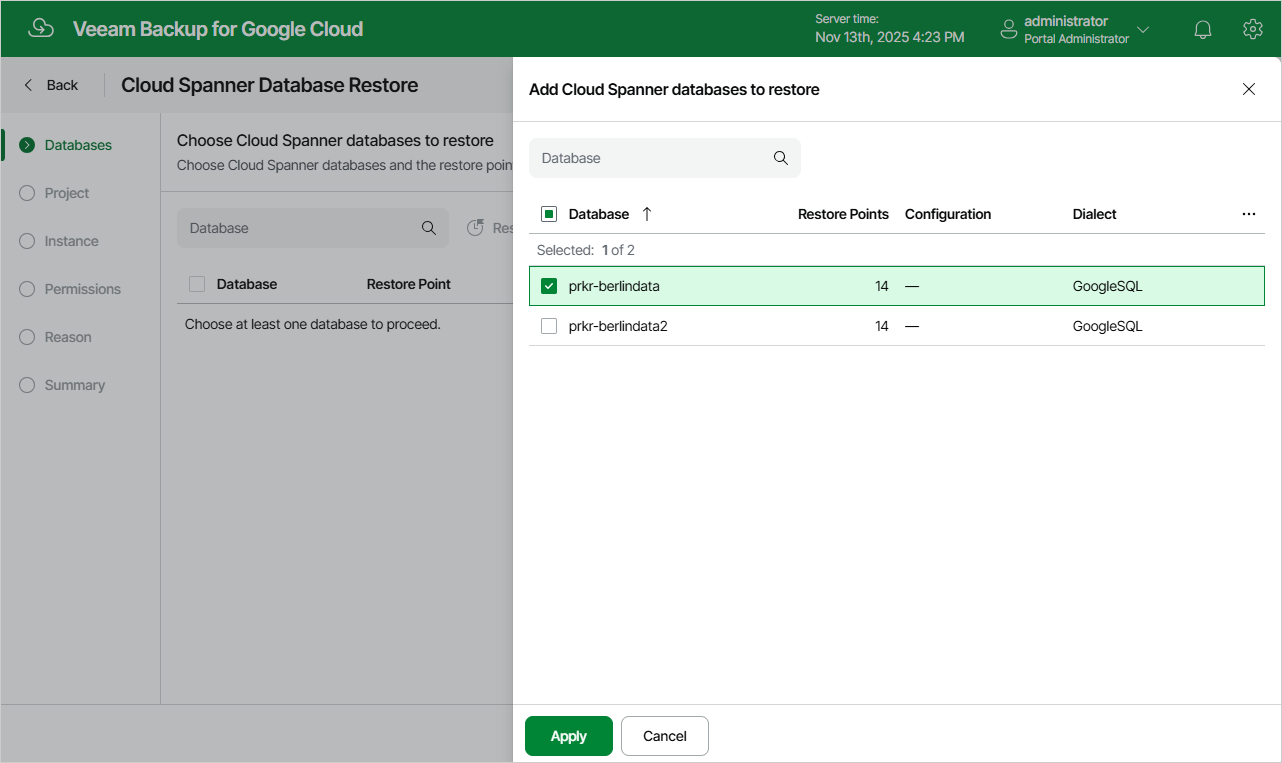
Step 2. Select Databases
At the Databases step of the wizard, click Add to select databases to restore, and then choose a restore point that will be used to restore the selected databases. By default, Veeam Plug-In for Google Cloud uses the most recent valid restore point. However, you can restore the backed-up data to an earlier state.
To select a restore point, do the following:
- Select a database and click Restore Point.
- In the Choose restore point window, select the necessary restore point and click Apply.
To help you choose a restore point, Veeam Plug-In for Google Cloud provides the following information on each available restore point:
- Creation Time — the date when the restore point was created.
- Destination — the type of the restore point:
- Snapshot — a cloud-native snapshot created by a backup policy.
- Manual Snapshot — a cloud-native snapshot created manually.
- Backup — an image-level backup created by a backup policy.
- Archive — an archived backup created by a backup policy.
- State — the health state of the restore point (the result of the latest health check; applies only to image-level backups).
- Storage Class — the storage class of the backup repository where the restore point is stored (applies only to image-level backups).
- Region — a region in which the protected Cloud Spanner instance resides.
- Policy — a backup policy that created the restore point.
- Retention — a retention configured for the backup policy that created the restore point.