Backup Health Settings
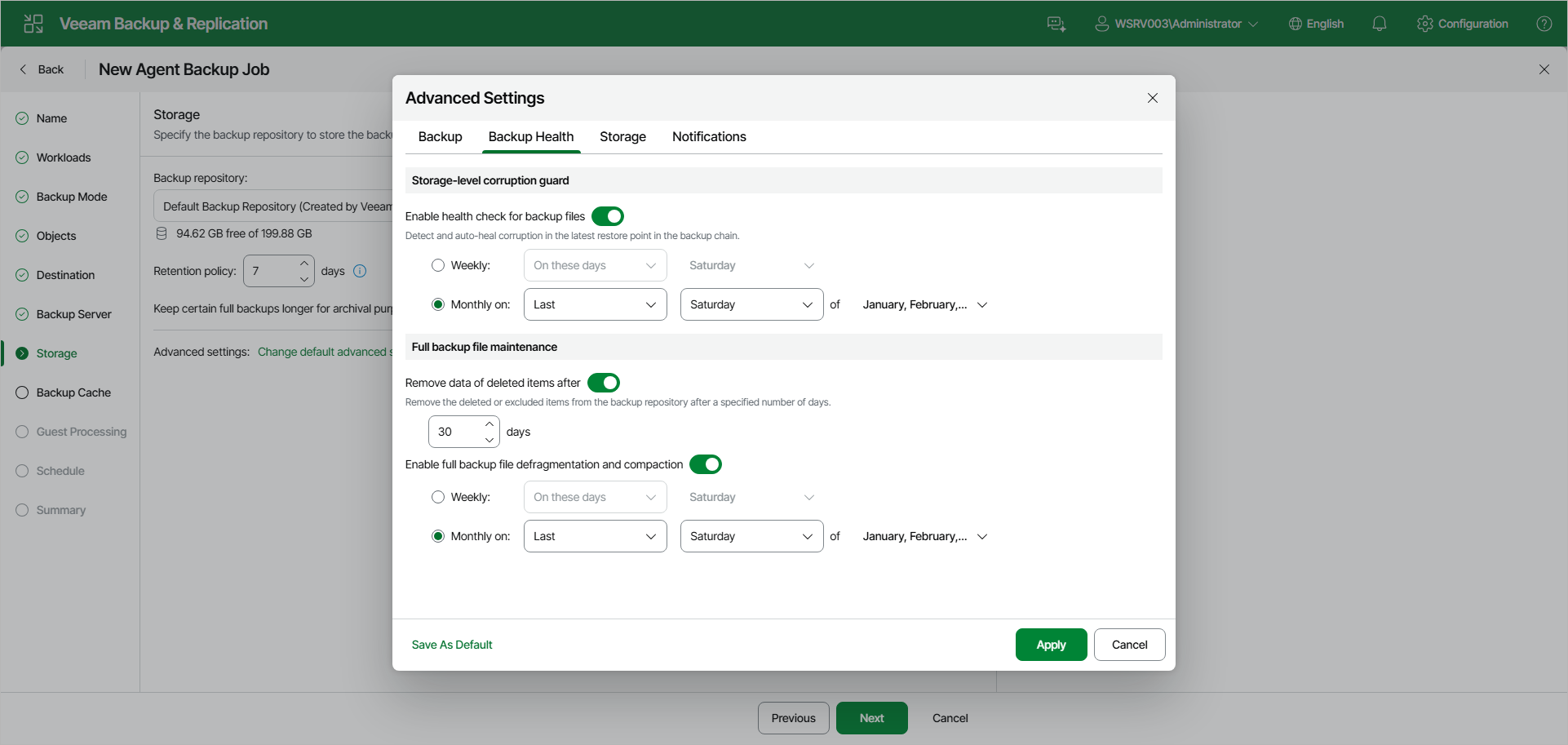
You can specify backup health settings for a backup chain created with the Veeam Agent backup policy. These operations help make sure that the backup chain remains valid and consistent.
To specify backup health settings for the backup policy:
- Open the Advanced Settings window at one of the following steps of the wizard:
- Storage — if you have selected to save backup files in a Veeam backup repository. Click Change default advanced settings.
- Local Storage — if you have selected to save backup files in a local storage of a Veeam Agent computer. Click Configure advanced settings.
- Shared Folder — if you have selected to save backup files in a network shared folder. Click Configure advanced settings.
- In the Advanced Settings window, go to the Backup Health tab.
- To periodically perform a health check for the latest restore point in the backup chain, under Storage-level corruption guard, turn on the Enable health check for backup files toggle. Then select Weekly or Monthly on and specify the scheduling settings in the drop-down lists.
An automatic health check can help you avoid a situation where a restore point gets corrupted, making all dependent restore points corrupted, too. If during the health check Veeam Agent for Microsoft Windows or Veeam Backup & Replication detect corrupted data blocks in the latest restore point in the backup chain (or the restore point before the latest one if the latest restore point is incomplete), it will start the health check retry and transport valid data blocks from the Veeam Agent computer to the target location. The transported data blocks are stored to a new backup file or the latest backup file in the backup chain, depending on the data corruption scenario.
For Veeam Agent backup policies, the health check process is the same as for Veeam Agent backup jobs configured directly on a Veeam Agent computer. For more information, see the Health Check for Backup Files section in the Veeam Agent for Microsoft Windows User Guide.
|
NOTE |
|
For object storage, Veeam Agent offers a special health check mechanism as default. To run the health check for object storage, turn on the Enable health check for backup files toggle in the Storage-level corruption guard section and specify the health check schedule. You can also switch from the health check for object storage to the standard health check. To do so, select the Verify content of each object in backup check box in the backup policy settings. Keep in mind that enabling this setting may result in additional charges from your object storage provider. |
- [For backup policies targeted at a Veeam backup repository] Under Full backup file maintenance, turn on the Remove data of deleted items after toggle and specify the number of days for which you want to keep the backup created with the backup policy in the target location.
If Veeam Agent does not create new restore points for the backup, the backup will remain in the target location for the period that you have specified. When this period is over, the backup will be removed from the target location. For more information, see the Retention Policy for Outdated Backups section in the Veeam Agent for Microsoft Windows User Guide.
By default, the deleted items data retention period is 30 days. Do not set the deleted items retention period to 1 day or a similar short interval. In the opposite case, the backup policy may work not as expected and remove data that you still require.
|
NOTE |
|
The Remove data of deleted items after toggle is not available if you have selected the Local storage or Shared folder option at the Destination step of the wizard. |
- To periodically defragment and compact a full backup, turn on the Enable full backup file defragmentation and compaction toggle. Then select Weekly or Monthly on and specify the scheduling settings in the drop-down lists. During the compact operation, data blocks from the full backup file are copied to a new empty file. As a result, the full backup file gets defragmented, and the speed of reading from and writing to the backup file increases.
|
NOTE |
|
The Enable full backup file defragmentation and compaction option is not available for backup policies targeted at object storage. |
If the full backup file contains data blocks for deleted drives, Veeam Agent for Microsoft Windows will remove these data blocks. For more information, see the Compact of Full Backup File section in the Veeam Agent for Microsoft Windows User Guide.
|
NOTE |
|
Consider the following:
|