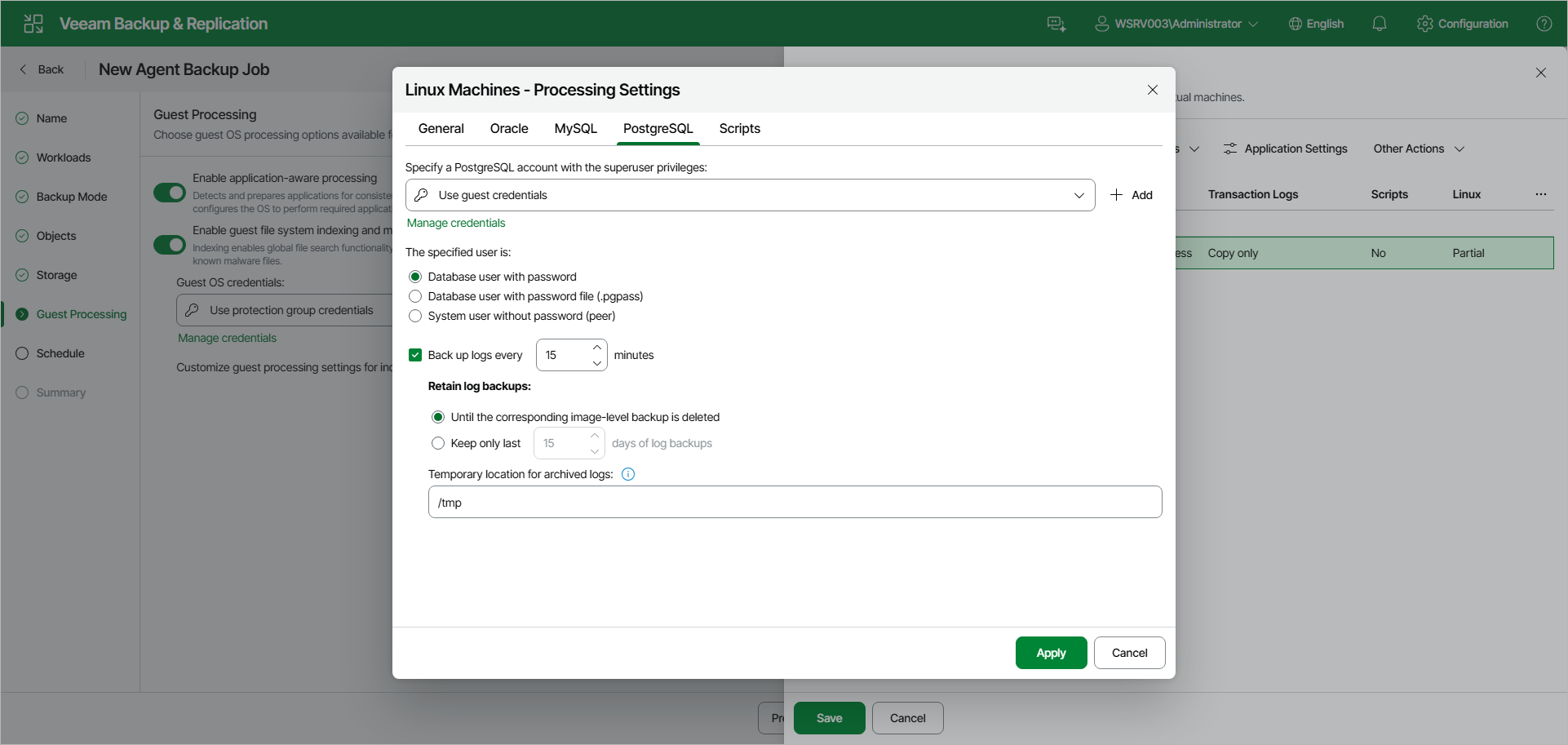
PostgreSQL Processing Settings
You can specify how Veeam Agent for Linux must process the PostgreSQL database system.
Before You Begin
Before you configure PostgreSQL processing, consider the Requirements and Limitations.
|
NOTE |
|
By default, Veeam Agent recursively scans the /etc/postgresql, /var/lib/postgresql and /var/lib/pgsql directories for the configuration files of PostgreSQL instances. If you keep configuration files in custom directories, the pgsqlagent agent will use its own VeeamPostgreSQLAgent.xml configuration file that is located in the /etc/veeam/ directory. The pgsqlagent agent configuration file must be a single line XML. To explicitly include or exclude specific configuration files from rescan, you can add the following commands to the VeeamPostgreSQLAgent.xml file:
For example: <config AddConfigDirs="/opt/psql/" ExcludeConfigDirs="/var/lib/postgresql/13/main45/,/var/lib/postgresql/13/maindd/" /> |
Configuring PostgreSQL Processing
To specify how Veeam Agent for Linux must process a PostgreSQL database system:
- At the Guest Processing step of the wizard, make sure that the Enable application-aware processing toggle is on.
- Click Customize.
- In the Customize Guest Processing Settings window, select the check box next to the protection group or individual computer and click Application Settings on the toolbar.
- In the Processing Settings window, on the General tab, make sure that Require successful processing or Try application processing, but ignore failures is selected in the Applications section.
- Open the PostgreSQL tab.
- From the Specify a PostgreSQL account with the superuser privileges drop-down list, select a user account that Veeam Agent for Linux will use to connect to the PostgreSQL database.
If you have not set up credentials beforehand, click the Manage credentials link or click Add on the right to add credentials.
By default, the Use guest credentials option is selected. With this option selected, Veeam Agent for Linux will connect to the PostgreSQL database under the account specified in the Guest OS credentials drop-down list at the Guest Processing step of the wizard.
Keep in mind that if you plan to select the peer authentication method at step 7 of this procedure, you can add a user account in the Credentials Manager without specifying the password for the account.
- Database user with password
- Database user with password file (.pgpass)
- System user without password (peer)
The The specified user is setting is connected closely with the Specify a PostgreSQL account with the superuser privileges drop-down list. Veeam Agent will do the following depending on what you specified using these two controls.
|
Control |
Veeam Agent Behavior |
|
|---|---|---|
|
Specify a PostgreSQL Account with the Superuser Privileges |
The Specified User Is |
|
|
The Use guest credentials option is selected. |
The Database user with password option is selected. |
|
|
The Database user with password file (.pgpass) option is selected. |
|
|
|
The System user without password (peer) option is selected. |
|
|
|
The user account is specified. |
The Database user with password option is selected. |
|
|
The Database user with password file (.pgpass) option is selected. |
|
|
|
The System user without password (peer) option is selected. |
|
|
- To back up PostgreSQL archived logs with Veeam Agent, select the Back up logs every check box and specify the frequency for archived logs backup in minutes. By default, archived logs are backed up every 15 minutes. The minimum log backup interval is 5 minutes. The maximum log backup interval is 480 minutes.
- In the Retain log backups section, specify retention policy for archived logs stored in the backup location:
- Select Until the corresponding image-level backup is deleted to apply the same retention policy for Veeam Agent backups and archived log backups.
- Select Keep only last to keep archived logs for a specific number of days. By default, archived logs are kept for 15 days. If you select this option, you must make sure that retention for archived logs is not greater than retention for the Veeam Agent backups. The maximum time period to keep archived logs is 60 days.
- In the Temporary location for archived logs field, specify a temporary storage location for the archived logs. The default location is /tmp.
During backup, Veeam Agent saves archived logs to the temporary storage, moves logs to a Veeam backup repository and deletes logs from the temporary storage. Keep in mind the following:
- Directory set as a temporary storage location must be locally accessible by the guest OS and have enough free space.
- If a temporary storage location for the archived logs is not specified or Veeam Agent cannot save logs in the specified directory for some reason, Veeam Agent will not be able to back up logs.
For more information on how Veeam Agent for Linux processes the PostgreSQL database system, see the PostgreSQL Backup section in the Veeam Agent for Linux User Guide.